
Danny Graham on Reconciliation, Restorative Justice, and the Work of Trust
In this Friends United Reconciliation Talk, Nancy Regan speaks with Danny Graham about reconciliation, restorative justice, treaty relationships, and the long work of building trust.
Danny reflects on his legal background, his work with Mi’kmaq leaders, and the importance of relationships, humility, and lifelong learning in the process of reconciliation.
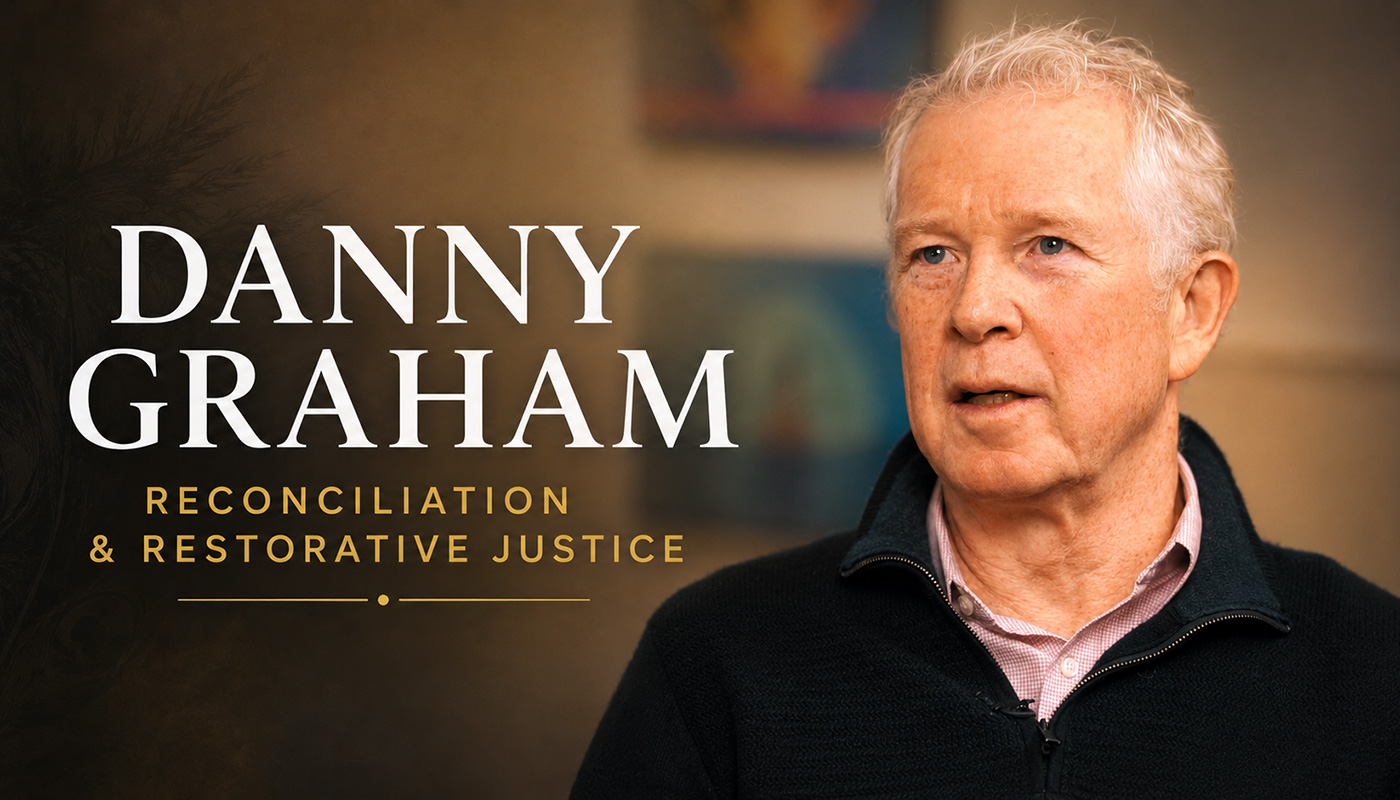
Video: 63 minutes, English – Watch on YouTube
Reconciliation as a Process of Relationship
In this conversation, Danny Graham describes reconciliation as a layered and ongoing process. He speaks about personal responsibility, institutional change, legal relationships, community healing, and the need to approach reconciliation with humility rather than certainty.
For Danny, reconciliation is not only a matter of agreements or policies. It is rooted in relationships, trust, and a willingness to listen deeply. He reflects on the importance of seeing one another with respect, recognizing different worldviews, and understanding that reconciliation also includes responsibility toward future generations.
Restorative Justice and a Different Way of Seeing Accountability
Danny shares how his work as a defence lawyer helped him see the stories behind people who came into contact with the justice system. That experience shaped his interest in restorative justice and in approaches to accountability that focus on healing, responsibility, community, and relationship.
He explains that restorative justice has been informed by Indigenous perspectives, while also recognizing that there is no single version of restorative justice that belongs to all communities. What remains central is the understanding that strong communities are built through connection, accountability, and care.
Learning from Mi’kmaq Leaders and Treaty Relationships
Danny reflects on his years working in Nova Scotia’s Aboriginal rights and reconciliation processes, including conversations with Mi’kmaq leaders and communities. He speaks about the importance of the Peace and Friendship Treaties, the Marshall decisions, and the continuing work of understanding what it means to say that we are all treaty people.
Throughout the interview, Danny emphasizes that reconciliation moves at the speed of trust. It requires patience, openness, unlearning, and the courage to remain with difficult questions.
Art, Healing, and the Friends United Initiative
Nancy and Danny also discuss the role of Friends United and the power of art as a way to open hearts, build bridges, and create space for reflection. Danny describes Friends United as a meaningful example of individual responsibility and sees art as a powerful language for reconciliation because it can reach people beyond words.
The conversation closes with a shared recognition that reconciliation is not a destination. It is a journey of relationship, learning, humility, and love.
In this conversation
- Danny Graham reflects on reconciliation as an ongoing process rooted in relationships, trust, and humility.
- He speaks about his background in law and how his work as a defence lawyer shaped his understanding of people’s stories.
- He explains how restorative justice offers a different way of thinking about accountability, healing, and community.
- He shares what he learned through his work with Mi’kmaq leaders and Aboriginal rights and reconciliation processes in Nova Scotia.
- He discusses the importance of the Peace and Friendship Treaties, the Marshall decision, and the idea that we are all treaty people.
- He emphasizes that reconciliation requires listening, unlearning, patience, and respect for future generations.
- Nancy Regan and Danny explore how art can open hearts, support healing, and create space for meaningful dialogue.
- The conversation highlights Friends United as an example of individual responsibility, bridge-building, and reconciliation through art.
People and context
Video information
Series: Second Annual Reconciliation Talks
Title: Reconciliation Unveiled: A Journey with Nancy Regan & Danny Graham
Interview with: Danny Graham and Nancy Regan
Language: English
Length: 1 hour 2 minutes
Location: Friends United International Convention Centre, Unama’ki, Cape Breton, Nova Scotia, Canada
YouTube URL: Watch the Video on YouTube
Published: November 28, 2024
Main topics: Reconciliation, restorative justice, treaty relationships, Mi’kmaq leadership, Peace and Friendship Treaties, the Marshall decision, Aboriginal rights, trust, lifelong unlearning, Engage Nova Scotia, individual responsibility, art, healing, Friends United, Rolf Bouman, and reconciliation through relationship.
Chapters: Friends United Opening; Defining Reconciliation; Welcome to the Talks; Danny’s Roots and Upbringing; Defense Law and Storytelling; Restorative Justice Journey; Connection and Equality; Parenting with Circle Process; Learning from Mi’kmaq Leaders; Treaties and Marshall Decision; Trust and Lifelong Unlearning; Engage Nova Scotia Explained; Art as Reconciliation; Closing Thanks and Outro.